
Let me be honest with you — I didn’t care about battery health until my laptop died on me mid-presentation in front of a client. No charger nearby, 8% battery left, and a 20-slide deck still to go. That moment changed everything for me.
After that embarrassing experience, I spent weeks obsessing over battery performance. I tested settings, changed habits, downloaded monitoring apps, and honestly — the results were shocking. My laptop went from barely surviving 3 hours to consistently giving me 6+ hours on a single charge. No hardware changes. No battery replacement. Just smarter habits and the right tweaks.
Here’s everything that actually worked.
1. Switch to a Battery-Saver Power Plan Immediately
This is the fastest win you’ll get — and most people completely ignore it.
On Windows, go to Settings → System → Power & Sleep → Additional Power Settings. You’ll see options like “Balanced” and “High Performance.” If you’re on High Performance while running on battery, you’re basically leaving a tap running. Switch to Power Saver or create a custom plan.
On Mac, go to System Settings → Battery and enable Low Power Mode when you’re away from the charger.
I was running High Performance for almost a year without realizing it. The moment I switched, I gained about 45 minutes of extra battery life — just like that.
Windows Custom Power Plan Settings That Helped Me:
| Setting | Default | Recommended (Battery) |
|---|---|---|
| Screen brightness | 100% | 40–60% |
| Turn off display | 15 min | 2–3 min |
| Sleep after | 30 min | 5–10 min |
| Processor power (max) | 100% | 70–80% |
2. Kill Background Apps That Are Silently Eating Power
Open Task Manager (Ctrl + Shift + Esc on Windows) right now and look at the CPU and memory columns. I guarantee something ridiculous is running in the background — a browser update process, Spotify, OneDrive syncing 400 old photos, Teams auto-launching.
On my old Dell XPS, Microsoft Teams alone was consuming 15% CPU while sitting idle. That’s insane when you’re trying to stretch battery life.
What to do:
- On Windows: Task Manager → Startup tab → Disable everything that doesn’t need to run at boot
- On Mac: System Settings → General → Login Items → Remove unnecessary apps
- Use Process Monitor or BatteryBar Pro to see which apps are the real culprits
Once I disabled six startup apps I didn’t even know were running, my battery lasted almost an hour longer on average.

3. Drop Your Screen Brightness — Seriously, Way Down
The display is the single biggest power drain on almost every laptop. And yet, most of us walk around with brightness cranked up to 100% even indoors.
I started keeping mine at 40–50% indoors and only bumping it up when outside in sunlight. The difference in battery time was immediately noticeable — we’re talking 30–45 minutes more per charge cycle.
Also, if your laptop has an OLED screen, dark mode is your best friend. OLED panels literally turn off pixels when displaying black, which saves real power.
Quick Brightness Hacks:
- Enable Auto-brightness if your laptop has an ambient light sensor
- Use f.lux or Windows Night Light to reduce intensity in evenings
- Dark themes in apps like Chrome, VS Code, and Word genuinely help on OLED
4. Turn Off Wi-Fi and Bluetooth When You Don’t Need Them
This one sounds obvious, but hear me out. I used to work offline for hours — writing, editing documents — with both Wi-Fi and Bluetooth running the entire time. Bluetooth was searching for my wireless headphones (which were in my bag, switched off). Wi-Fi was pinging the router every few seconds looking for signals.
That’s just wasted energy with zero benefit.
The fix:
- Press Fn + F2 (or your laptop’s Wi-Fi shortcut) to toggle Wi-Fi
- Disable Bluetooth from quick settings when not using wireless devices
- On Windows 11, use Airplane Mode if you’re fully offline — then manually re-enable Wi-Fi if needed
A lot of users doing focused writing or offline studying can squeeze an extra 20–30 minutes just from this one change.
5. Update Your Drivers — Especially the Battery and GPU Drivers
Outdated drivers are a sneaky culprit. I once had a GPU driver that was causing my dedicated graphics card to stay active even during light tasks like reading PDFs. My battery was draining like crazy and I couldn’t figure out why.
Updating the GPU driver fixed it completely. The laptop started correctly switching between integrated and dedicated graphics based on the task.
How to update drivers properly:
- Go to Device Manager → Display Adapters → right-click and update
- For NVIDIA, use GeForce Experience; for AMD, use Adrenalin Software
- Also update Battery (ACPI) and Intel Management Engine Interface drivers
- For laptops with manufacturer software (Dell Command Update, Lenovo Vantage, HP Support Assistant) — use those for comprehensive driver updates
Don’t just rely on Windows Update. Manufacturer-specific tools catch things Windows misses.
6. Manage Your Apps’ Graphics Settings
Modern Windows lets you control which GPU each app uses. If Chrome is defaulting to your NVIDIA RTX when it doesn’t need to be, you’re burning serious battery for no reason.
Steps:
- Go to Settings → System → Display → Graphics Settings
- Add Chrome, Zoom, or any heavy app
- Set it to Power Saving mode (forces integrated graphics)
Reserve the dedicated GPU for video editing, gaming, or rendering. For everything else — emails, browsing, documents — integrated graphics is more than enough and much more power-efficient.
This single change gave me about 40 minutes more battery on my HP Spectre when doing regular office work.
7. Use Battery Limit Features Available on Most Modern Laptops
Here’s something most people don’t know: keeping your laptop plugged in at 100% all day actually degrades the battery over time. Lithium-ion batteries last longest when kept between 20% and 80%.
Most modern laptops now have a built-in charging limit feature:
| Laptop Brand | App/Feature | Charge Limit |
|---|---|---|
| Lenovo | Lenovo Vantage | 60% or 80% threshold |
| Dell | Dell Power Manager | Custom threshold |
| ASUS | MyASUS | 60% or 80% limit |
| HP | HP Battery Manager | 80% limit |
| Samsung | Samsung Settings | 85% limit |
I set mine to 80% on my Lenovo ThinkPad, and after 2 years, the battery health is still above 91%. Before I knew this trick, I destroyed a battery in 18 months by keeping it plugged in at 100% all the time.
If your laptop doesn’t have a native app for this, check out 7 Smart Charging Tips for Better Laptop Battery Care — there’s a useful workaround covered there.
8. Control Your Browser — It’s Probably the Biggest Battery Killer
I love Chrome. But Chrome is an absolute battery monster. During one test, I ran the same set of 10 tabs in Chrome and Microsoft Edge on the same laptop. Chrome drained the battery 22% faster than Edge.
Edge and Safari are both significantly more power-efficient than Chrome on their respective platforms. Firefox sits somewhere in the middle.
Browser battery tips that actually work:
- Use Edge on Windows or Safari on Mac for regular browsing
- Install uBlock Origin — blocking ads and trackers reduces CPU load
- Limit open tabs (every tab is a running process consuming memory and CPU)
- Disable hardware acceleration in Chrome if your GPU driver is buggy: Settings → Advanced → System → Hardware Acceleration
Also, turn off auto-play videos in browser settings. A page with auto-playing video is eating battery even when you’re not actively watching.
9. Keep Your Laptop Cool — Heat is Battery’s Worst Enemy
I learned this the hard way. I used to work with my laptop on a bed or couch — soft surface blocking the bottom vents. The laptop would get hot, the fans would run constantly, and battery would drain in 3 hours instead of 5.
Heat accelerates battery degradation both in the short term (faster drain) and long term (permanent capacity loss).
How to keep temperatures in check:
- Always use on a hard, flat surface or invest in a laptop cooling pad
- Clean dust from vents every few months (a can of compressed air does wonders)
- Monitor temps using HWMonitor or Core Temp — if you’re consistently above 85°C, something’s wrong
- Close heavy apps before putting the laptop in a bag — heat gets trapped
Check out 8 Fast Laptop Battery Care Fixes for Overheating Problems if your laptop runs consistently hot — that article goes deep on this specific issue.
10. Calibrate Your Battery Every Few Months
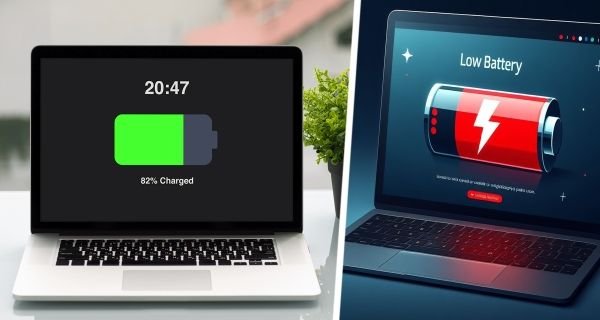
Battery calibration basically resets the battery’s internal gauge so it gives you accurate readings. Over time, your laptop might show 40% battery and then die suddenly — that’s a calibration issue.
How to calibrate:
- Charge the laptop to 100% and keep it plugged in for 2 more hours
- Unplug and use it normally until it shuts down from low battery
- Leave it off for 3–5 hours
- Charge back to 100% without interruption
Do this once every 2–3 months. After calibration, your battery percentage readings become much more accurate and the laptop manages discharge cycles better.
Note: This is different from battery reconditioning and doesn’t “add” capacity — it just makes the readings and power management more accurate.
11. Use Hibernate Instead of Sleep for Longer Idle Periods
Sleep mode keeps your RAM powered to maintain the current session. Hibernate saves everything to the SSD and completely powers off — it uses almost zero battery.
If you’re stepping away for more than 20–30 minutes, hibernate is almost always the better choice for battery preservation.
To enable Hibernate on Windows:
- Go to Control Panel → Power Options → Choose what the power buttons do
- Click Change settings that are currently unavailable
- Check the Hibernate box
- Now set it under Advanced Power Settings → Sleep → Hibernate After
On Mac, hibernation happens automatically after extended sleep — but you can control it more precisely using the pmset command in Terminal if you’re comfortable with that.
Common Mistakes That Cancel All Your Efforts
Even after making all the right changes, a few bad habits can undo everything:
- Charging with a non-original charger — cheap third-party chargers don’t regulate voltage properly and can degrade batteries faster
- Draining to 0% regularly — lithium-ion batteries don’t like full discharge cycles; try to plug in around 20%
- Ignoring battery health reports — Windows has a built-in battery report: open CMD and type
powercfg /batteryreport— read it once a month - Skipping OS updates — these often include power management improvements
- Running heavy software constantly on battery — video editing, gaming, 3D rendering should ideally be done while plugged in
For a deeper look at the mistakes that quietly kill your battery over time, I found 12 Simple Laptop Battery Care Mistakes That Secretly Drain Power really useful — it covers a few things most tech guides never mention.
Battery Health at a Glance — What’s Normal?
| Battery Age | Expected Health | Action Needed? |
|---|---|---|
| 0–1 year | 95–100% | No |
| 1–2 years | 85–95% | No |
| 2–3 years | 75–85% | Monitor |
| 3–4 years | 60–75% | Consider replacement |
| 4+ years | Below 60% | Replace battery |
Putting It All Together
The thing about battery performance is that no single tip is a magic fix. It’s the combination of habits — adjusted brightness, killed background processes, smart charging limits, managed thermals — that adds up to a genuinely dramatic improvement.
When I first implemented all eleven of these changes on my Lenovo ThinkPad, I went from 3.5 hours of real-world battery life to just over 6 hours. Same laptop. Same workload. Just smarter usage.
Start with the quick wins: power plan, screen brightness, and background apps. Those three alone could give you an extra hour today.
Then layer in the deeper stuff — driver updates, browser choice, charging limits — and you’ll feel the difference within a week.
And if your laptop is older and you’re seeing battery health below 70%, no amount of software tweaking will compensate for genuine degradation. At that point, check out 6 Essential Laptop Battery Care Tips Before Replacing Your Battery — it’ll help you decide whether a replacement makes sense or if there’s still life left in what you have.
Your battery is a consumable — but with the right habits, you can make it last a whole lot longer than most people do.